Home/Collection/Leica M3
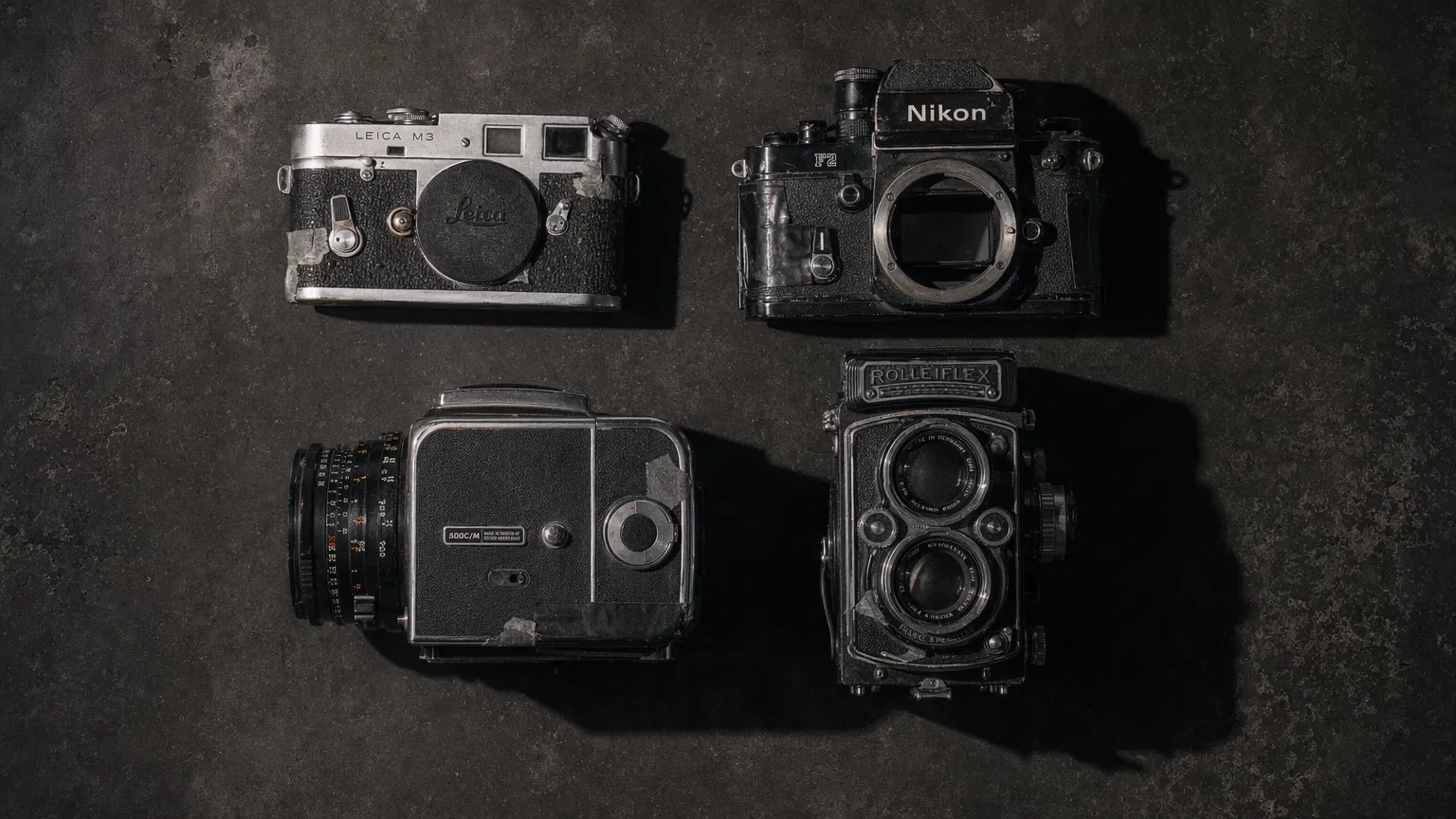
Leitz / 1954 / 35mm
Leica M3
The one I reach for first. Every time.
Overview
Leica M3
Wetzlar, Germany
I've owned this M3 for eleven years. It came to me from an estate sale in Sarasota -- double-stroke, chrome, serial number in the 700,000s, which puts it at 1957. The previous owner had it serviced sometime in the 1980s and then put it in a drawer. The shutter was slow at 1/1000 and the rangefinder patch was dim. Three hours of work and it was back.
The M3 is the camera I reach for when I want to think about the photograph and nothing else. The 0.91x viewfinder is the largest of any Leica M. With a 50mm lens, you see more than the frame lines show. You're aware of what's outside the frame. That matters.
I've shot Portra 400 through it in Tampa at noon and Cinestill 800T through it at night. It handles both without complaint. The shutter is quiet enough to use in situations where a Nikon would be rude.
Specifications
Type
Rangefinder
Year introduced
1954
Shutter
Cloth focal plane, 1s -- 1/1000
Viewfinder
0.91x magnification
Frame lines
50mm, 90mm, 135mm
Film advance
Double-stroke (early), single-stroke (late)
Meter
None
Mount
Leica M bayonet
Body material
Brass, chrome or black paint
Weight
580g (body only)
Dimensions
138 x 77 x 33mm
Production run
1954 -- 1966, approx. 220,000 units
History
The M3 was introduced at Photokina in 1954 and immediately made the screw-mount Leicas it replaced look obsolete. The bayonet mount was faster to use. The combined viewfinder and rangefinder was brighter and clearer. The film loading system, while still fiddly by modern standards, was an improvement.
Early M3s had a double-stroke film advance -- two short strokes to advance one frame. Leitz switched to single-stroke in 1958. The double-stroke cameras are not better or worse to use; they're just different. Some people prefer the feel. I don't have a strong opinion.
Production ran until 1966, when the M4 replaced it. The M4 added a 35mm frame line and a faster film loading system. The M3's finder is still larger. Leitz never made another M with a 0.91x finder. They probably should have.
In Florida, M3s turn up occasionally at estate sales and flea markets. Most of them have been sitting in humid conditions for decades. The light seals are always gone. The rangefinder patch is usually dim. The shutter speeds are usually slow. None of this is a problem if you know what you're doing.
Worth owning?
The M3 is worth owning if you shoot 50mm or longer on 35mm film and you want the best optical viewfinder experience available in a 35mm camera. The 0.91x finder is not a small difference. It's the difference between peering through a porthole and looking through a window.
It's not worth owning if you shoot 35mm wide-angle lenses. The M3 has no 35mm frame lines. You can use a separate viewfinder in the hot shoe, but that defeats the purpose. Get an M6 or an M4 if you shoot wide.
The lack of a meter is not a problem. It's a feature. You learn to read light. You carry a small meter if you need one. Or you use the Sunny 16 rule and stop worrying about it.
Prices have climbed. A clean, working M3 in chrome will cost you $1,200 to $2,000 depending on condition and seller. Black paint examples are significantly more. Budget another $150 to $300 for a CLA if the camera hasn't been serviced recently. It's worth it.
Common faults
Slow shutter speeds
The 1s and 1/2s speeds run slow on most unserviced M3s. Old lubricant on the slow-speed governor. Needs cleaning and fresh lubricant.
Dim rangefinder patch
The beam splitter coating degrades over time. A dim patch makes focusing in low light difficult. Some can be cleaned; some need the beam splitter replaced.
Sticky shutter
Old lubricant migrates onto the shutter curtains. The shutter fires but the curtains drag. Needs a full CLA.
Worn film advance
Double-stroke M3s develop play in the advance mechanism. Usually a worn ratchet. Repairable but requires disassembly.
Light leaks
The foam seals around the back door degrade. Always replace them on any M3 that hasn't been recently serviced.
Rangefinder misalignment
The rangefinder can drift out of alignment, especially after a drop. Horizontal and vertical adjustment is possible with the right tools.
CLA notes
A Leica M3 CLA takes me about four hours. The shutter comes out as a unit. The slow-speed governor gets cleaned and re-lubricated with a very small amount of the right grease -- too much and the slow speeds run fast, too little and they run slow. I use Molykote DX for the governor and Nye Lubricants Tribolube for the shutter curtain rails.
The rangefinder adjustment is done last, after everything else is back together and the shutter speeds are verified. Horizontal adjustment is via a screw accessible through the front of the camera. Vertical adjustment requires removing the top plate.
In Florida, I pay particular attention to the light seals and the foam bumpers inside the camera. The humidity here accelerates foam degradation. I replace them with self-adhesive felt cut to size. The original foam is never worth saving.
After a CLA, I run a roll of cheap film through the camera before trusting it with anything important. I check the shutter speeds with a Calumet ShutterSpeed tester and verify the rangefinder accuracy at 1m, 3m, and infinity.
Related